
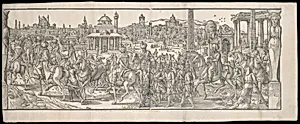
Procession of Sultan Süleyman through the Atmeidan from the frieze Ces Moeurs et fachons de faire de Turcz (Customs and Fashions of the Turks)
Medium
Woodcut
Dimensions
Sheet: 13 7/8 × 34 3/8 in. (35.2 × 87.3 cm)
Classification
Prints
Department
Drawings and Prints
Museum
Metropolitan Museum of Art, New York, NY
Credit
Harris Brisbane Dick Fund, 1928
Accession Number
28.85.7a, b
Rights
Public Domain
Tags
About this artwork
This woodcut depicts Sultan Süleyman's ceremonial procession through the Atmeidan (Hippodrome) in Constantinople, from the series "Ces Moeurs et fachons de faire de Turcz" (Customs and Fashions of the Turks), published in 1553. The print shows the Ottoman sultan's elaborate retinue, capturing the pageantry and ceremonial protocol of the Ottoman court with numerous figures, horses, and architectural elements. The composition presents a panoramic view of the procession, demonstrating Renaissance i...
Art Historical Context
This captivating woodcut, *Procession of Sultan Süleyman through the Atmeidan*, captures the grandeur of Ottoman pageantry in 16th-century Constantinople. Created as part of the frieze *Ces Moeurs et fachons de faire de Turcz* ("Customs and Fashions of the Turks"), published in 1553, it depicts Sultan Süleyman the Magnificent's ceremonial parade through the Atmeidan (ancient Hippodrome), teeming with elaborately dressed courtiers, horses, and architectural wonders. Flemish artist Pieter Coecke van Aelst sketched the scenes firsthand during his 1533 trip to the city, seeking tapestry commissions from the sultan, while his widow, Mayken Verhulst, brought the series to print two decades after his death. The woodcut medium—ideal for expansive horizontal compositions—allowed for this panoramic view, making it one of Europe's earliest visual ethnographies of Ottoman life. Amid Renaissance fascination with distant cultures, amid political tensions and trade with the expanding Ottoman Empire, the print documents rituals like processions, funerals, and festivals, blending detailed observation with artistic flair from the Northern Renaissance tradition. Housed in the Metropolitan Museum of Art, this 13⅞ × 34⅜-inch sheet offers a vivid window into a world of splendor and protocol, highlighting cross-cultural curiosity that shaped early modern Europe.
About the Artist
Pieter Coecke van Aelst|Mayken Verhulst · 1502–1550
Pieter Coecke van Aelst (1502–1550) was a leading Flemish artist of the Renaissance, renowned for his multifaceted talents as a painter, sculptor, architect, and designer of tapestries, stained glass, woodcuts, and metalwork. Born in Aalst, in the Southern Netherlands (modern-day Belgium), he likely studied under Bernaert van Orley, a prominent Antwerp painter, before becoming a master in the city...