
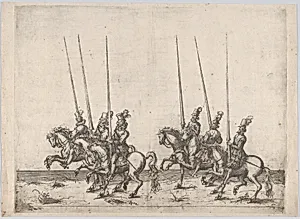
Procession, with six men riding horses
16th century
Medium
Etching
Dimensions
Sheet: 12 5/16 × 16 15/16 in. (31.2 × 43 cm) Plate: 11 3/4 × 15 9/16 in. (29.8 × 39.5 cm)
Classification
Prints|Prints-Fete|Ornament & Architecture
Department
Drawings and Prints
Museum
Metropolitan Museum of Art, New York, NY
Credit
Harris Brisbane Dick Fund, 1953
Accession Number
53.601.333(7)
Rights
Public Domain
Tags
Art Historical Context
This 16th-century etching, titled *Procession, with six men horses*, captures a dynamic equestrian parade by an anonymous German artist. composition features six mounted men advancing in formation, their attire and weapons suggesting a ceremonial or festive event—perhaps a tournament, hunt, or civic celebration. Rendered on a substantial sheet (12 5/16 × 16 15/16 in.), the print's intricate details highlight the riders' postures, horse tack, and armaments, evoking the grandeur of Renaissance-era pageantry. Etching, a revolutionary technique in 16th-century Germany, involved coating a metal plate with acid-resistant ground, incising lines, and immersing it in acid to bite the grooves for inking and printing. Pioneered by German artists like Daniel Hopfer, it allowed for fine, expressive lines surpassing woodcuts, making elaborate scenes like this accessible through multiples. Classified under Prints-Fête, Ornament & Architecture, it reflects the era's fascination with decorative motifs and public spectacles amid the Northern Renaissance. Housed in the Metropolitan Museum of Art's Drawings and Prints department (Harris Brisbane Dick Fund, 1953), this anonymous work offers a window into everyday German cultural life, where horses and weaponry symbolized status and communal ritual. Its survival underscores etching's role in preserving ephemeral processions for posterity.