
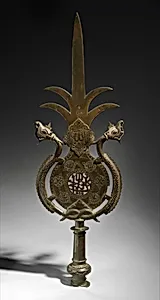
Processional Standard ('Alam)
Unknown Artist
late 17th–early 18th century
Medium
Brass
Dimensions
H. 38 in. (96.5 cm) W. 12 in. (30.5 cm)
Classification
Metal
Department
Islamic Art
Museum
Metropolitan Museum of Art, New York, NY
Credit
Purchase, Friends of Islamic Art Gifts, 2013
Accession Number
2013.37
Rights
Public Domain
Tags
Art Historical Context
This striking brass *Processional Standard ('Al)* from the late 17th to early 18th century the masterful metalwork of Islamic art. Standing nearly 38 inches tall and 12 inches wide, was designed to be carried aloft during religious processions, serving as a powerful emblem of devotion. Crafted from durable brass, a favored medium in Islamic workshops for its malleability and lustrous finish, the standard likely features intricate repoussé techniques—hammering the metal from the reverse to create raised motifs—allowing for bold, three-dimensional forms visible from afar. In the context of Shia Muslim traditions, 'alams like this one were central to Muharram commemorations, symbolizing the martyrdom of Imam Husayn and evoking spiritual fervor among participants. The inclusion of dragon imagery, as suggested by its motifs, draws from a rich iconographic tradition blending Persian, Indian, and Central Asian influences, where mythical creatures represented protection and cosmic power. These fantastical elements added a layer of awe-inspiring drama to public rituals. Today, this *'alam* at the Metropolitan Museum of Art invites us to appreciate the fusion of artistry and faith, highlighting how everyday metal transformed into sacred icons that united communities in the vibrant Islamic world of centuries past.