
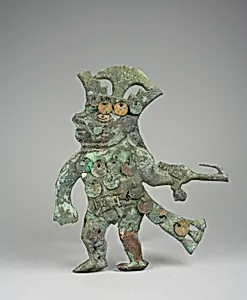
Profile Warrior Ornament
Unknown Artist
6th–7th century
Medium
Gilded copper, shell, turquoise
Dimensions
H. 7 1/2 x W. 6 5/16 in. (19.1 x 16 cm)
Classification
Metal-Ornaments
Culture
Moche
Department
Arts of Africa, Oceania, and the Americas
Museum
Metropolitan Museum of Art, New York, NY
Credit
Bequest of Jane Costello Goldberg, from the Collection of Arnold I. Goldberg, 1986
Accession Number
1987.394.72
Rights
Public Domain
Tags
Art Historical Context
This exquisite *Profile Warrior Ornament*ails from the Moche culture of ancient Peru, crafted between the 6th and 7 centuries CE. The Moche, flourishing along Peru's northern coast from around 100–700 CE, were masterful artisans for their intricate metalwork and vivid depictions of warriors, deities, and ritual scenes. This small yet striking piece, measuring just 7½ by 6⅜ inches, likely served as a pectoral ear ornament, or ceremonial adornment, reflecting the elite status of its wearer in a society where warriors held prominent roles in warfare and sacrifice rituals. Forged from gilded copper—a technique involving a thin layer of gold over copper for a luxurious sheen—the ornament is enriched with inlays of shell and turquoise, showcasing the Moche's advanced metallurgical skills. These materials not only enhanced its visual appeal but also carried symbolic weight: turquoise evoked preciousness and the sea, while shell suggested coastal abundance. The profile view of the warrior, with its detailed headdress and fierce posture, exemplifies Moche realism and dynamism, blending functionality with storytelling. On view in the Metropolitan Museum of Art's Arts of Africa, Oceania, and the Americas department, this bequest from the Goldberg collection offers a window into Moche power and artistry, reminding us how personal ornaments embodied cultural identity and martial prowess in pre-Columbian America.