
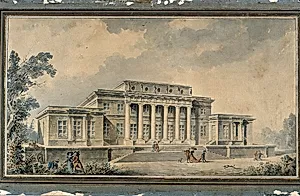
Project for a Country Villa
ca. 1765–70
Medium
architecture
Classification
architecture
Department
Smithsonian Collection
Museum
Smithsonian American Art Museum
Credit
Purchased for the Museum by the Advisory Council
Accession Number
1911-28-99
Rights
Public Domain
About this artwork
Research in Progress
Art Historical Context
Claude-Nicolas Led (1736–1806), a visionary French architect of the Enlightenment era, created *Project for a Country Villa* around 1765–. This architectural design reflects the neoclassical ideals that defined Ledoux's innovative approach, emphasizing symmetry, geometric purity, and harmony with nature. As one of Paris's leading architects, Ledoux blended rationalist principles with bold utopian visions, often prioritizing philosophical concepts over practical execution. The work, housed in the Smithsonian American Art Museum's architecture collection, exemplifies Ledoux's early projects, which imagined ideal country estates as symbols of social order and moral elevation. Purchased for the museum by the Advisory Council, it highlights his influence on modern architecture, foreshadowing movements like modernism through its abstracted forms and emphasis on function. Though research on this specific piece is ongoing, it captures the 18th-century shift toward rational, monumental designs amid France's pre-Revolutionary fervor. Visitors will appreciate how Ledoux's villa project transcends mere blueprints, inviting reflection on architecture's power to shape enlightened living.