
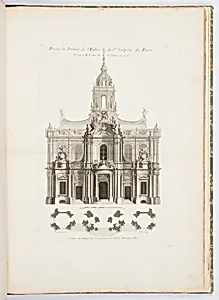
Projet du Portail de l'Eglise de St. Sulpice de Paris (Design for the Portal of the Church of St. Sulpice of Paris), plate 105, in Oeuvres de Juste-Aurèle Meissonnier (Works by Juste-Aurèle Meissonnier)
Classification
architecture
Department
Smithsonian Collection
Museum
Smithsonian American Art Museum
Credit
Purchased for the Museum by the Advisory Council
Accession Number
1921-6-212-63
Rights
Public Domain
About this artwork
Research in Progress
Art Historical Context
Juste-Aurèle Meissonnier (1695–1750), a visionary Franco-Italian architect and designer, created this intricate *Projet du Portail de'Eglise de St. Sulpice de Paris* 1748 as plate 105 in his publication *Oeuvres de Just-Aurèle Meissonnier*. Born in Turin, Italy, Meissier rose to prominence in 18th-century Paris, embodying the exuberant Rococo style with its playful asymmetry, scrolling motifs, and sculptural fantasy. This architectural design captures his flair for opulent church portals, envisioning a grand entrance for the iconic St. Sulpice, a Baroque masterpiece whose construction spanned decades. As part of Meissonnier's celebrated *Oeuvres*, a portfolio of engravings showcasing his innovative visions, this plate highlights the era's shift from rigid Classicism to Rococo's whimsical elegance. Though the medium remains unidentified—likely an etching or line engraving—it exemplifies how printed designs disseminated bold ideas among Europe's elite patrons and architects. Meissonnier's work influenced Versailles furnishings and urban ornamentation, blending Italian roots with French sophistication. Today, housed in the Smithsonian American Art Museum's architecture collection (purchased by the Advisory Council), this piece invites visitors to ponder unrealized grandeur. Research continues, but it stands as a testament to Rococo's fleeting, fantastical spirit amid Enlightenment rationalism.