
Proposal for the Trevi Fountain
1730/1732
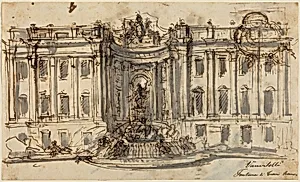
Medium
pen and brown ink with gray wash on laid paper
Dimensions
overall: 14.5 x 24 cm (5 11/16 x 9 7/16 in.)
Classification
Drawing
Department
CG-E
Museum
National Gallery of Art, Washington, D.C.
Credit
William B. O'Neal Fund
Accession Number
1999.140.1
Rights
Public Domain
Art Historical Context
Step into the world of 18th-century Roman architecture with Luigi Vanvitelli *Proposal for the Trevi Fountain* (1730/1732), a delicate drawing that captures the ambition of one of the city's grandest projects. Vanvitelli, a leading Italian architect known for his Baroque flair and later triumphs like the Royal Palace of Caserta, this design amid a prestigious competition launched by Pope Clement XII. Trevi Fountain, envisioned as a monumental Baroque celebration of water and mythology, drew visionary proposals from Europe's finest talents, though Nicola Salvi's design ultimately prevailed. Crafted in pen and brown ink with gray wash on laid paper—measuring a modest 14.5 x 24 cm—this preparatory drawing exemplifies the precision of architectural sketches from the era. The fine lines delineate structural forms, while subtle gray washes evoke shadows and depth, bringing the fountain's cascading waters and sculptural drama to life on a small scale. Such techniques allowed architects to convey scale, movement, and grandeur to patrons without full-scale models. Housed in the National Gallery of Art through the William B. O'Neal Fund (Department CG-E), this artifact offers a rare glimpse into the creative rivalries behind Rome's iconic landmark. It reminds us how drawings like this fueled the Baroque imagination, blending engineering prowess with artistic splendor.
About the Artist
Luigi Vanvitelli · 1700–1773
Born 12 May 1700; died 1 March 1773. Famous for his design for the Royal Palace at Caserta, built 1751. Vanvitelli was active in Rome, Naples and nearby towns, also Brescia, Milan and Genoa. Comment on works: Portraits