
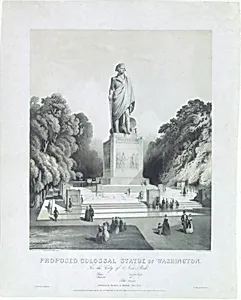
Proposed Colossal Statue of George Washington for the City of New York
Thomas Crawford|Frederick Catherwood|G. Thomas|Francis Michelin|Bartlett & Welford, 1845
About this artwork
In 1845, American sculptor Thomas Crawford proposed this ambitious design for a colossal statue of George Washington to grace New York City, capturing the era's fervor for monumental tributes to the nation's founding father. Rendered as a tinted lithograph by printers Frederick Catherwood, G. Thomas, Francis Michelin, and publishers Bartlett & Welford, the image depicts Washington in heroic neoclassical pose amid trees, evoking Roman emperors and symbolizing enduring American ideals of liberty and leadership. This print, from the Metropolitan Museum of Art's Edward W. C. Arnold Collection, served as a powerful promotional tool, rallying public and civic support for grand public art in a young republic eager to rival Europe's landmarks. Lithography with tint stone—a technique using colored stones for subtle hues—brought the sculptural vision to life on paper, making the towering figure accessible and vivid. At over 16 inches tall in image size, it highlighted Crawford's skill in blending classical grandeur with patriotic symbolism, though the statue was never realized at this scale. Today, it offers a window into 19th-century urban aspirations and Washington's mythic status, reminding visitors how prints like this fueled cultural debates on national identity and commemoration.