
Purse Mount
Unknown Artist
first half of the 7th century
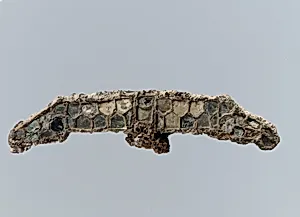
Medium
base silver or copper alloy (frame and cloisons), glass
Dimensions
Overall: 4 13/16 x 1 1/8 x 3/8 in. (12.3 x 2.8 x 1 cm)
Classification
Metalwork
Culture
Frankish
Department
Medieval Art
Museum
Metropolitan Museum of Art, New York, NY
Credit
Gift of J. Pierpont Morgan, 1917
Accession Number
17.191.163
Rights
Public Domain
Art Historical Context
Step into the world of early medieval Europe with this exquisite *Purse Mount*, crafted by an unknown Frankish artisan in the first half of 7th century. Hailing from the Merovingian era—the height of Frankish power under kings like Clovis and his successors—this small yet stunning metalwork piece (4 13/16 x 1 1/8 x 3/8 in.) adorned the purses of the elite, serving as both a practical fastener and a symbol of wealth and status.ated to the Metropolitan Museum of Art in 1917 by J. Pierpont Morgan, it now resides in the Medieval Art department, offering a glimpse into daily life among the Frankish nobility. What makes this purse mount a treasure is its masterful use of cloisonné technique, where thin frames and cloisons of base silver or copper alloy create delicate cells filled with vibrant glass enamel. This labor-intensive method, inherited from Byzantine and late Roman traditions but adapted by Frankish craftsmen, produced shimmering, jewel-like effects without precious gems. The result? A compact marvel of precision engineering and artistry, highlighting the sophisticated metalworking skills that flourished in post-Roman Gaul. Frankish culture bridged the classical world and the Middle Ages, and objects like this underscore their role in preserving and innovating artistic techniques amid political upheaval. Imagine a warrior or merchant proudly displaying it— a tiny testament to an era of transformation.