
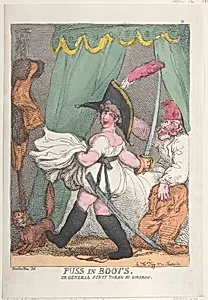
Puss in Boots or General Junot Taken by Surprise
[April 12, 1811], reprint
Medium
Hand-colored etching
Dimensions
Sheet: 13 11/16 × 9 5/8 in. (34.8 × 24.5 cm)
Classification
Prints
Department
Drawings and Prints
Museum
Metropolitan Museum of Art, New York, NY
Credit
The Elisha Whittelsey Collection, The Elisha Whittelsey Fund, 1959
Accession Number
59.533.1408
Rights
Public Domain
Tags
Art Historical Context
Step into the witty world of early 19th-century British satire with *Puss in Boots or General Junot Taken by*, a hand-colored etching created by Thomas Rowlandson and by Thomas Tegg in 1811 (this is a later reprint). Measuring about 13¾ × 9⅝ inches, this print from the Metropolitan Museum of Art's Elisha Whittelsey Collection captures Rowlandson's signature style: exaggerated figures, bawdy humor, and sharp social commentary rendered in intricate etching lines brought to life with vibrant hand-coloring. The title playfully nods to the fairy tale *Puss in Boots* while lampooning Jean-Andoche Junot, the French marshal and duc d'Abrantes under Napoleon. Likely mocking a scandalous or embarrassing moment—hinted at by tags like men, women, cats, and beds—Rowlandson skewers Junot's military bravado amid the Napoleonic Wars. British caricaturists like Rowlandson thrived on such jabs, boosting public morale by ridiculing French foes through bedroom farce and feline mischief. This etching exemplifies the era's print culture, where affordable, colorful satires shaped public opinion. Its lively technique and cheeky narrative make it a delightful window into wartime propaganda and Rowlandson's enduring legacy as a master of humorous caricature.
About the Artist
Thomas Rowlandson|Thomas Tegg|Jean Andache Junot, duc d'Abrantes · 1756–1827
Thomas Rowlandson (1757–1827) was an English artist and caricaturist whose satirical watercolors and prints captured the social life of Georgian Britain with unparalleled wit and technical mastery. Alongside James Gillray, he is recognized as one of the greatest British graphic artists, and his distinctive flowing line and keen observations have made his work integral to understanding late 18th an...