
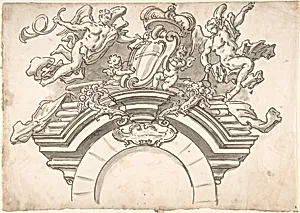
Putti Supporting Coat of Arms above Archway
17th–18th century
Medium
Pen and brown ink, brush and gray-brown wash, over traces of graphite underdrawing
Dimensions
sheet: 8 9/16 x 12 in. (21.8 x 30.5 cm)
Classification
Drawings|Ornament & Architecture
Department
Drawings and Prints
Museum
Metropolitan Museum of Art, New York, NY
Credit
The Elisha Whittelsey Collection, The Elisha Whittelsey Fund, 1949
Accession Number
49.50.115
Rights
Public Domain
Tags
Art Historical Context
Nestled in the Metropolitan Museum of Art's Drawings and Prints department, this delicate 17th- or th-century Italian drawing, *Putti Supporting Coat of above Archway*, captures playful exuberance of Baroque ornamentation. Anonymous hands crafted a preparatory design for an architectural feature, where chubby putti—cherubic child figures symbolizing innocence and divine joy—hoist a heraldic coat of arms atop a graceful archway. These motifs were staples in Italian palazzos, churches, and villas, blending heraldry with whimsical fantasy to adorn facades or interiors for nobility and clergy. Executed on a modest sheet measuring 8 9/16 x 12 inches, the work employs pen and brown ink for precise lines, enhanced by brush and gray-brown wash for subtle shading, all over faint graphite underdrawing. This mixed-media technique was ideal for architects and designers, allowing quick iterations of decorative schemes before sculpting stucco or frescoing walls—a testament to the era's fusion of architecture and fine art. Part of The Elisha Whittelsey Collection (acquired 1949), this piece offers a window into Italy's rich tradition of ornamental drawings, highlighting how everyday motifs like putti elevated heraldry into lively, enduring symbols of status and spirituality. A charming glimpse of artistry in motion!