
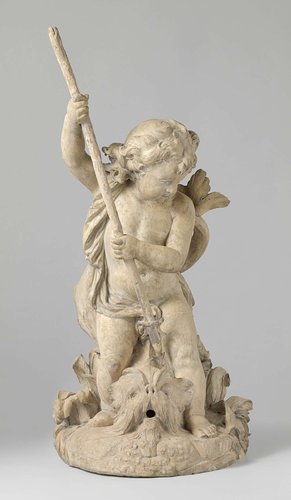
Putto met dolfijn
ca. 1750
Medium
modeling
Dimensions
39.6; 48; 48; 102
Rights
Public Domain
About this artwork
height 102 cm x width 48 cm x depth 48 cm x weight 39.6 kg
Art Historical Context
Edme Bouchardon's "Putto met dolfijn," created around 1750, captures the playful charm of an 18th-century French sculpture. As a modeled work standing just over a meter tall and weighing nearly 40 kilograms, it likely served as a preparatory study or finished terracotta piece. Bouchardon, a leading sculptor of his time, blended Rococo elegance with emerging Neoclassical restraint, favoring balanced forms drawn from classical antiquity. The subject—a cherubic putto alongside a dolphin—reflects popular decorative motifs of the period, often linked to fountains and garden designs symbolizing vitality and the sea. Such figures appeared in Bouchardon's public commissions, including Parisian fountains, where they added lively, human-scale interest to grand architectural settings. This intimate scale invites viewers to appreciate the artist's sensitive handling of volume and movement, achieved through direct modeling techniques that preserved the warmth of the hand-shaped surface. The work offers a glimpse into mid-18th-century tastes for graceful, mythological themes rendered with technical precision.
About the Artist
Edme Bouchardon · 1698–1762
Born 29 May 1698; died 27 July 1762. Bouchardon was a student of Guillaume Coustou, and won the prix de Rome in 1722. He spent ten years (1722-1732) in Rome, Italy working on various projects for Pope Clement XII. In 1732 Bouchardon was recalled to Paris and named sculptor to the king. Bouchardon became a professor at the Académie Royale in 1746. He worked on an equestrian monument of Louis XV, Ki...