
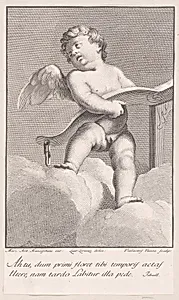
Putto with a yoke
Medium
Etching and engraving
Dimensions
Sheet (Trimmed): 11 5/8 × 6 7/8 in. (29.6 × 17.5 cm)
Classification
Prints
Department
Drawings and Prints
Museum
Metropolitan Museum of Art, New York, NY
Credit
The Elisha Whittelsey Collection, The Elisha Whittelsey Fund, 1951
Accession Number
51.501.2796
Rights
Public Domain
Tags
Art Historical Context
In the whimsical world of 18th Italian art, *Putto with a Yoke* (1774) captures the essence of a putto—a chubby, winged infant figure symbolizing love, innocence, divine joy. Created as an etching and engraving by Lorenzo Lorenzi, Viol Vanni, and Marconio Franceschini, this likely reproduces designs from the vibrant Bolognese Baroque tradition, such cherubs adorned frescoes, altarpieces, and decorative schemes. Franceschini, a master of exuberant Rococo-inflected figures, contributed to its lively spirit, evoking the era's delight in mythological whimsy. The medium of etching and engraving was revolutionary for its time, allowing intricate details—like the putto's expressive face, flowing curls, and the yoke's rustic curve—to be precisely reproduced and widely shared among artists, collectors, and enthusiasts. Measuring a modest 11 5/8 × 6 7/8 inches (trimmed), this intimate sheet from The Metropolitan Museum of Art's Elisha Whittelsey Collection highlights printmaking's role in democratizing high art during the Enlightenment. Today, it invites us to ponder the yoke's subtle symbolism—perhaps a nod to youthful burdens or pastoral harmony—reminding visitors of putti's enduring charm in bridging sacred and secular realms. A delightful gem for any virtual tour!
About the Artist
Lorenzo Lorenzi|Violante Vanni|Marcantonio Franceschini (Italian|Italian) · 1750 |1700 –1780 |1800
Italian, active ca. 1750–80|Italian, active Florence, 18th century