
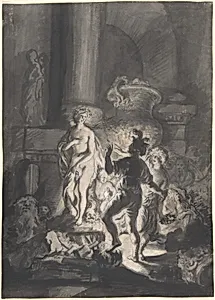
Pygmalion
Medium
Brush and gray and black wash, heightened with white.
Dimensions
Overall: 16 x 11 9/16 in. (40.7 x 29.4 cm)
Classification
Drawings
Department
Drawings and Prints
Museum
Metropolitan Museum of Art, New York, NY
Credit
Purchase, Karen B. Cohen Gift and Sotheby's Inc. Gift, 1996
Accession Number
1996.414
Rights
Public Domain
Tags
Art Historical Context
Joachim von Sandrart *Pygmalion* (1662) is a captivating drawing that brings the ancient Greek myth to life. In the story, the sculptor Pygmalion a flawless ivory statue of Galatea, falls deeply in love with it, and prays to Venus for her animation—a tale of creation, desire, and divine intervention that resonated in Baroque art. Sandrart, a prominent German-Dutch artist and art theorist known for his encyclopedic *Teutsche Academie*1675), captures this moment with Pygmalion tenderly embracing the awakening nude figure, blending classical mythology with 17th-century emotional intensity. Executed in brush with gray and black wash heightened with white gouache on paper (16 x 11 9/16 in.), the work exemplifies Baroque drawing techniques. The wash creates subtle tonal gradations and dramatic chiaroscuro, while white heightening adds luminous highlights, mimicking the sheen of living flesh emerging from stone. This grisaille-like method was ideal for preparatory studies, allowing artists to model forms with sculptural depth and prepare for paintings or engravings. Acquired by the Metropolitan Museum of Art in 1996 through generous gifts, *Pygmalion* highlights Sandrart's mastery of the nude and his role in disseminating Italianate ideals across Northern Europe. For visitors, it offers a window into how Baroque artists humanized myths, celebrating the transformative power of art itself.