
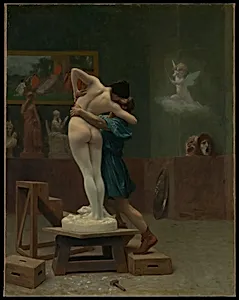
Pygmalion and Galatea
ca. 1890
Medium
Oil on canvas
Dimensions
35 x 27 in. (88.9 x 68.6 cm)
Classification
Paintings
Department
European Paintings
Museum
Metropolitan Museum of Art, New York, NY
Credit
Gift of Louis C. Raegner, 1927
Accession Number
27.200
Rights
Public Domain
Tags
Art Historical Context
Jean-Léon Gérôme’s *Pygmalion and Galatea* (ca. 1890) brings to life the ancient myth from Ovid’s *Metamorphoses*, in which a sculptor falls in love with his ivory statue, only for the goddess Aphrodite to grant her life. The oil-on-canvas scene shows Pygmalion embracing the awakening Galatea, with Cupid hovering nearby to underscore the moment of transformation. Gérôme’s precise brushwork captures the subtle shift from cool marble to warm flesh, inviting viewers to witness both artistic creation and romantic fulfillment. A leading academic painter of the nineteenth century, Gérôme was celebrated for his technical mastery and interest in classical subjects. Working at a time when photography was emerging, he used the medium’s capacity for luminous detail and smooth surfaces to heighten the illusion of living stone. The painting’s modest scale—35 by 27 inches—encourages an intimate encounter, much like the sculptor’s private studio. Acquired by the Metropolitan Museum of Art through the 1927 gift of Louis C. Raegner, the work remains a vivid example of how nineteenth-century artists reinterpreted antiquity to explore enduring themes of desire, artistry, and the miraculous power of love.
About the Artist
Jean-Léon Gérôme · 1824–1904
Gérôme's father, a goldsmith from Vesoul, discouraged his son from studying to become a painter but agreed, reluctantly, to allow him a trial period in the studio of Paul Delaroche in Paris. He traveled and studied in Italy, elsewhere in Europe, and in Asia Minor. The subjects that he enjoyed most were scenes of nature and animals. He is best known for mythological and Comment on works: history pa...