
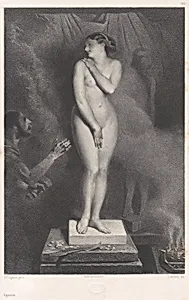
Pygmalion and Galatea
Medium
Lithograph
Dimensions
Sheet: 17 1/4 × 11 3/16 in. (43.8 × 28.4 cm)
Classification
Prints
Department
Drawings and Prints
Museum
Metropolitan Museum of Art, New York, NY
Credit
Museum Accession, transferred from the Library
Accession Number
22.106.36(5-10)
Rights
Public Domain
Tags
Art Historical Context
Step into the enchanting world of classical mythology with *Pygmalion and Galatea*, a captivating lithograph created around 1852–62 by French artists Jean-François Gigoux andélestin Nanteuil with printing by Bertauts, P. Cadet, Paris. This 17¼ × 11⅛-inch print, now housed in the Metropolitan Museum Art's Drawings and Prints, depicts the timeless tale from Ovid's *Metamorph*: the sculptor Pygmalion, who carves a flawless ivory statue of the beautiful Galatea, falls deeply in love with his creation, and prays for her to come alive—miraculously granted by Venus. Lithography, a revolutionary 19th-century technique using greasy crayon on stone to produce detailed, tonal images, allowed artists like Gigoux (a Romantic painter known for dramatic scenes) and Nanteuil (a skilled printmaker) to reproduce intricate narratives affordably. This medium flourished in mid-century France amid a revival of classical themes, blending sensuous female nudes with male devotion to explore themes of creation, desire, and divine intervention—perfect for an era fascinated by antiquity amid rapid modernization. Gigoux and Nanteuil's collaboration captures the myth's erotic tension and transformative magic, making high art accessible to a wide audience. Transferred from the Met's Library via museum accession, this print invites visitors to ponder the blurred line between art and life, a enduring allure from Romanticism's golden age.
About the Artist
Jean-François Gigoux|Bertauts, P. Cadet, Paris|Célestin Nanteuil (French|French|French) · 1806 | |1813 –1894 | |1873
French, Besançon 1806–1894 Besançon| |French (born Italy), Rome 1813–1873 Bourron-Marlotte