
Pygmalion
Medium
etching and engraving
Classification
Department
CG-E
Museum
National Gallery of Art, Washington, D.C.
Credit
Rosenwald Collection
Accession Number
1949.5.512
Rights
Public Domain
Art Historical Context
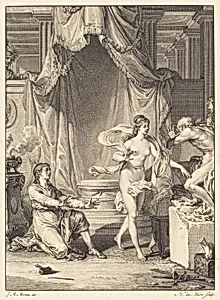
Step into the enchanting world of 18th-century French printmaking with *Pygmalion* (1778), an exquisite etching and engraving by Noël Le Mire after a design by Jean-Michel Moreau. This print captures the timeless myth of Pygmalion, the sculptor who fell in love with his own ivory statue of Galatea, brought to life by Venus—a tale of creation, desire, and divine intervention that captivated Enlightenment audiences. Moreau, a leading illustrator of his time, infused the scene with the graceful elegance of the Rococo style transitioning toward Neoclassicism, featuring fluid lines and idealized figures that evoke emotional depth. Le Mire, a master engraver, translated this vision using etching for its spontaneous, painterly effects and fine engraving for precise detailing, making the print a technical marvel. Such reproductive prints were revolutionary, democratizing access to high art beyond elite patrons. Housed in the National Gallery of Art's Rosenwald Collection (Department CG-E), this work highlights the cultural vogue for classical mythology in pre-Revolutionary France, where art bridged ancient lore and modern sentiment. A testament to collaborative genius, it invites visitors to ponder the blurred lines between artist, muse, and miracle.