
Pyramid monument for J.B. van Bree
1857 or after
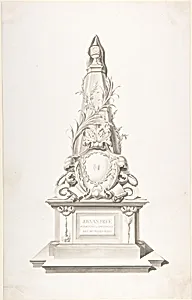
Medium
Pen and brush with gray ink, brush and gray wash, with traces of ruled graphite lines
Dimensions
sheet: 18 1/8 x 11 1/2 in. (46 x 29.2 cm)
Classification
Drawings
Department
Drawings and Prints
Museum
Metropolitan Museum of Art, New York, NY
Credit
The Elisha Whittelsey Collection, The Elisha Whittelsey Fund, 1960
Accession Number
60.632.24
Rights
Public Domain
Tags
Art Historical Context
This delicate drawing by G. Fock, titled *Pyramid Monument for J.B. van Bree* and dated 1857 or, captures a neoclassical vision of eternal remembrance. Rendered on a modest sheet measuring 18⅛ × 11½ inches, it depicts a towering pyramid adorned with leafy motifs, evoking ancient Egyptian grandeur reimagined in 19th-century Europe. Such pyramidal forms were popular for funerary monuments during this era, symbolizing stability and the afterlife amid Romantic interests in antiquity and nature. Fock employed precise techniques typical of architectural draftsmen: pen and brush with gray ink for sharp lines, layered with gray wash for subtle shading and depth. Traces of ruled graphite lines reveal the preparatory precision, underscoring its role as a design study rather than a finished work. Housed in The Metropolitan Museum of Art's Drawings and Prints department, this piece from The Elisha Whittelsey Collection highlights the meticulous planning behind public monuments. The interplay of monumental scale and organic leaf details reflects 19th-century tensions between human ambition and nature's ephemerality, offering visitors a window into the artistry of commemoration.