
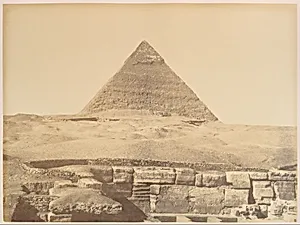
Pyramides de Gizèh
Gustave Le Gray, 1865–69
About this artwork
In the mid-19th century, photographer Gustave Le Gray revolutionized landscape photography with his masterful command of light and composition. His *Pyramides de Gizè* (1865–69), an albumen silver from a glass negative, the timeless grandeur of Egypt's Giza pyramids against a vast, luminous sky. Measuring 31.1 x 41.8 cm, this image transports viewers to the ancient wonders, evoking the awe of explorers who ventured to the Nile Valley during height of European fascination with Orientalism. Le Gray's innovation shines here: glass negatives enabled exceptional clarity and tonal depth in albumen prints, a process using egg whites to bind light-sensitive silver salts for rich, detailed reproductions. As a leader in the calotype movement, he often enhanced skies through combination printing—a subtle composite technique—infusing drama and atmosphere that elevated photography from mere documentation to fine art. Housed in the Metropolitan Museum of Art's Photographs Department (gift of Robert Shapazian, 2009), this work bridges antiquity and modernity, offering 19th-century audiences intimate access to pharaonic monuments. It reminds us how photography democratized the world's marvels, sparking enduring curiosity about human achievement across millennia.