
Pyramus and Thisbe
early 17th–mid 17th century
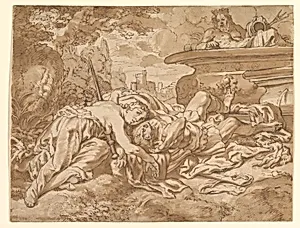
Medium
Pen and brown ink, brown wash, over black chalk
Dimensions
sheet: 7 3/16 x 5 3/16 in. (18.3 x 13.2 cm)
Classification
Drawings
Department
Drawings and Prints
Museum
Metropolitan Museum of Art, New York, NY
Credit
Purchase, Guy Wildenstein Gift, 2010
Accession Number
2010.370
Rights
Public Domain
Tags
Art Historical Context
In the intimate drawing *Pyramus and This*, created in the early to mid-17th century, artists Cornelis Schut, Dominique Joseph Eisen, and Adriaen van de Vel evoke the tragic tale from Ovid's *Metamorphoses*. This ancient myth of star-crossed lovers—separated by a wall, united only in death through a heartbreaking misunderstanding—resonates with themes of love and suffering, as hinted by the tags of anguished men, women, and lovers. The work captures a pivotal moment of despair, rendered on a modest sheet measuring just 7 3/16 x 5 3/16 inches, now housed in the Metropolitan Museum of Art's Drawings and Prints department. Executed in pen and brown ink with brown wash over black chalk, this piece exemplifies 17th-century European draftsmanship techniques. Black chalk provides a subtle underdrawing for form and shadow, while the fluid ink lines and translucent wash add emotional depth and drama, characteristic of Baroque interests in pathos and movement. Schut and van de Velde, both tied to Flemish and Dutch traditions, favored such media for studies that bridged sketches and finished compositions, showcasing virtuoso handling of light and texture. Acquired through the Guy Wildenstein Gift in 2010, this drawing highlights the enduring cultural fascination with classical narratives in Northern European art. It invites visitors to ponder how 17th-century artists reinterpreted ancient stories to explore human vulnerability, making it a poignant gem in the Met's collection.