
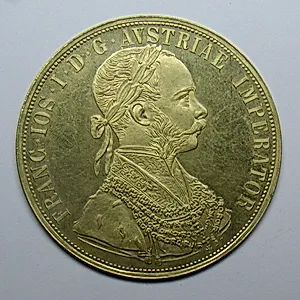
Quad ducat of Francis Joseph I, Emperor of Austria
Unknown Artist
19th century
Medium
Gold
Dimensions
Diameter: 2 1/4 in. (57 mm.)
Classification
Coins
Culture
Austrian
Department
European Sculpture and Decorative Arts
Museum
Metropolitan Museum of Art, New York, NY
Credit
Gift of H.R. Ickelheimer, 1909
Accession Number
09.9.8
Rights
Public Domain
Tags
Art Historical Context
Behold the *Quad Ducat of Francis Joseph I, Emperor of Austria*, a 19th-century gold that gleams with imperial grandeur. Measuring an impressive 2¼ inches (57 mm) in diameter, this oversized piece—four times the value of a standard ducatserved not just as currency but as a symbol of Habsburg prestige. Minted during the long reign of Francis Joseph I (18481916), who ruled the vast Austro-Hungarian Empire, it reflects the era's economic might and monarchic authority. Crafted in pure gold, the coin showcases exquisite engraving techniques typical of Austrian minting. One side likely features the emperor's dignified profile, capturing his stern yet regal visage, while the other displays the imperial coat of arms, emblematic of dynastic power and heraldry. As a work of decorative art, its large scale and fine detailing elevated it beyond mere money, often used for ceremonial gifts or state payments. Now housed in the Metropolitan Museum of Art's Department of European Sculpture and Decorative Arts—thanks to a 1909 gift from H.R. Ickelheimer—this coin invites us to ponder the artistry of empire. In a museum setting, it bridges numismatics and sculpture, reminding visitors of how everyday objects embodied 19th-century Europe's political splendor.