
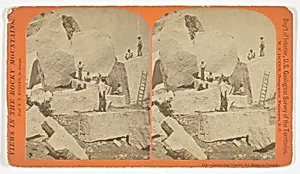
Quarrying Granite for Mormon Temple, No. 119 from the series "Views in the Rocky Mountains"
1870/78
Medium
Albumen print, stereo
Dimensions
Each image: 9.4 × 7.6 cm (3 3/4 × 3 in.); Card: 10 × 17.6 cm (3 15/16 × 6 15/16 in.)
Classification
stereograph (albumen)
Department
Photography and Media
Museum
Art Institute of Chicago
Accession Number
108772
Rights
Public Domain
Art Historical Context
William Henry Jackson’s “Quarrying Granite for Mormon Temple” (1870/78) captures the rugged labor behind one of the American West’s most ambitious building projects. As part of his celebrated series “Views in the Rocky Mountains,” the stereograph shows workers extracting stone destined for the Salt Lake Temple, then under construction in Utah Territory. Jackson, a pioneering expedition photographer, traveled with government surveys to document the landscapes and industries reshaping the frontier. The work is an albumen-print stereograph, a popular 19th-century format that paired two nearly identical images to produce a striking three-dimensional effect when viewed through a stereoscope. Such cards brought distant scenes of mountain quarries and construction sites into parlors across the country, shaping public understanding of western expansion and Mormon settlement. Today the print resides in the Art Institute of Chicago’s photography collection, offering visitors a vivid glimpse of both the physical effort and the technological ingenuity that defined Jackson’s era.