
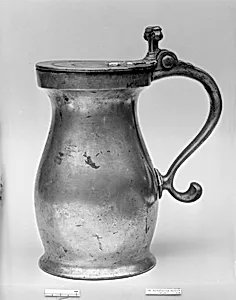
Quart Measure
Unknown Artist
1700–1800
Medium
Pewter
Dimensions
H. 7 7/8 in. (20 cm); Diam. 4 in. (10.2 cm)
Classification
Quart measure
Culture
British (American market)
Department
The American Wing
Museum
Metropolitan Museum of Art, New York, NY
Credit
Gift of Mrs. Russell Sage, 1909
Accession Number
10.125.462c
Rights
Public Domain
Art Historical Context
Step into the everyday world of 18th-century America with this elegant *Quart Measure*, a finely crafted pewter vessel from1700–1800. Standing at 7 7/8 inches tall with a 4-inch diameter, its simple, functional form—likely featuring a flared body and sturdy base—made it ideal for precisely measuring a quart of liquids like ale, cider, or milk. Produced by an unknown British artisan for the American market, it reflects the transatlantic trade that supplied colonial households with durable goods. Pewter, an alloy of tin and other metals, was prized for its silvery sheen, malleability, and resistance to corrosion, allowing it to be spun, hammered, or cast into practical shapes. In an era before standardized glassware, such measures ensured fair trade in taverns, markets, and homes, embodying the blend of British craftsmanship and American utility. Often bearing touchmarks from makers' guilds, these objects highlight the skilled metalworking traditions imported to the New World. Housed in The Metropolitan Museum of Art's American Wing and generously gifted by Mrs. Russell Sage in 1909, this unassuming piece offers a tangible link to colonial life. It reminds us how humble tools shaped daily commerce and community, preserving a slice of history in gleaming metal.