
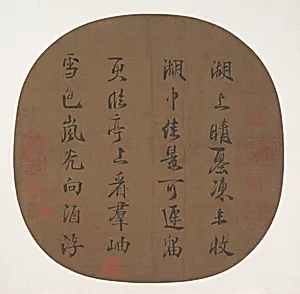
南宋 理宗趙昀 行書北宋梅堯臣 依韻和資政侍郎雪後登看山亭詩 團扇|Quatrain on Snow-covered West Lake
ca. 1250–60
Medium
Round fan mounted as an album leaf; ink on silk
Dimensions
Image: 9 7/8 × 9 7/8 in. (25.1 × 25.1 cm) Mat: 15 1/2 × 14 1/2 in. (39.4 × 36.8 cm)
Classification
Calligraphy
Culture & Period
China · Song dynasty (960–1279)
Department
Asian Art
Museum
Metropolitan Museum of Art, New York, NY
Credit
Bequest of John M. Crawford Jr., 1988
Accession Number
1989.363.18
Rights
Public Domain
Art Historical Context
Behold this exquisite round fan, transformed into an album leaf, the elegant running script (xingshu) of Emperorong (r. 1224–64) of China's Southern Song dynasty (1127–1279). Dated around 1250–60, it inscribes a quatrain echoing a poem by Northern Song poet Mei Yao (1002–1060). Titled *Quatrain on Snow-covered West Lake*, the verses evoke the serene beauty of Hangzhou's iconic West Lake blanketed in snow, as seen from a pavilion—a nod to classical literati traditions amid the elegance of imperial court life. In the Song era, calligraphy reigned as the pinnacle of artistic expression, blending poetry, philosophy, and brush mastery. Emperor Lizong's fluid xingshu style captures the dynasty's refined aesthetic: dynamic strokes in ink on silk convey rhythm and spontaneity, evoking winter's crisp tranquility. Fans like this were cherished personal objects, often exchanged among scholars and elites, mounting them as album leaves preserved their intimacy for posterity. This rare imperial work, now at The Metropolitan Museum of Art, highlights the Song rulers' scholarly pursuits during a time of cultural zenith before the Mongol conquest. Its silk surface enhances the ink's luminosity, inviting visitors to ponder how even emperors sought harmony with nature through art.