
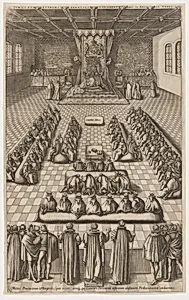
Queen Elizabeth in Parliament
published 1608
Medium
engraving
Dimensions
sheet: 30.8 × 19.5 cm (12 1/8 × 7 11/16 in.)
Classification
Department
CG-E
Museum
National Gallery of Art, Washington, D.C.
Credit
Rosenwald Collection
Accession Number
1951.11.102
Rights
Public Domain
Art Historical Context
**Queen Elizabeth in Parliament** is a striking 1608 engraving by Renold Elack, a leading English printmaker of the early 17th known for his detailed portraits of royalty and nobility. Measuring 30.8 × 19.5 cm, this print from the National Gallery of Art Rosenwald Collection captures the iconic Tudor monarch in a formal parliamentary setting, likely evoking her historic addresses to Parliament during her 45-year reign (15581603). Published five years after her death, served as a posthumous tribute, preserving her for a growing audience in an era when visual propaganda reinforced monarchical authority. Engraving, Elstrack's chosen medium, involved incising fine lines into a metal plate with a burin, allowing for intricate details like the queen's elaborate gown, throne, and attentive lords—hallmarks of Jacobean portraiture. This technique was revolutionary for its reproducibility, making regal imagery affordable beyond elite circles and disseminating Elizabeth's enduring legacy as the "Virgin Queen" who navigated religious strife and economic growth. Culturally, the print underscores Parliament's evolving role in English governance under Elizabeth, blending artistic precision with political symbolism. Visitors will appreciate how such works bridged art and history, immortalizing a ruler whose speeches, like her famous 1601 "Golden Speech," defined an age of exploration and national pride.
About the Artist
Renold Elstrack · 1571–1625
Renold Elstracke (c. 1570–after 1625), one of England's earliest native-born engravers, emerged as a pivotal figure in the late Elizabethan and Jacobean art world. Born to Josephe Elstrage, a migrant from "Lukeland" in the province of Liège (modern-day Belgium) who settled in England in 1551, Elstracke likely honed his craft under the tutelage of Crispin van de Passe the elder in Cologne before ar...