
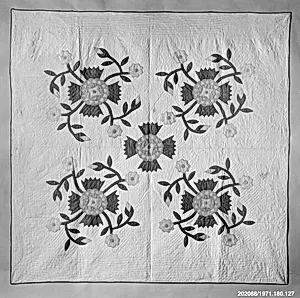
Quilt, Rose of Sharon pattern
Unknown Artist
ca. 1860
Medium
Cotton
Dimensions
83 3/4 x 84 5/16 in. (212.7 x 214.2 cm)
Classification
Quilt
Culture
American
Department
The American Wing
Museum
Metropolitan Museum of Art, New York, NY
Credit
Bequest of Flora E. Whiting, 1971
Accession Number
1971.180.127
Rights
Public Domain
Tags
Art Historical Context
This striking cotton quilt, created around 1860 in the United States, showcases the Rose of Sharon pattern, a beloved appliqué design featuring lush floral motifs arranged in symmetrical blocks. Measuring roughly 84 inches square, the piece reflects the meticulous handwork of its unknown maker, who layered and stitched cotton fabrics to create a vibrant, blooming composition. The medium of cotton was widely available and practical during this era, allowing for both durability and the vibrant dyes that bring the roses and surrounding foliage to life. Quilt-making in mid-19th-century America served as both a domestic necessity and a form of creative expression, often produced by women in their homes or through communal gatherings. The Rose of Sharon design, drawn from biblical imagery, carried symbolic weight as a token of love and affection, frequently appearing in bridal or friendship quilts exchanged among families. Its popularity spread across regions, blending English and Dutch textile traditions with distinctly American innovations in color and scale. Today, this quilt stands as a testament to the artistic skill and cultural importance of everyday objects in American life. Housed in the Metropolitan Museum of Art’s American Wing, it invites viewers to appreciate how such textiles transformed functional bedcovers into enduring works of folk art that continue to inspire.