
R. & Co.
1865
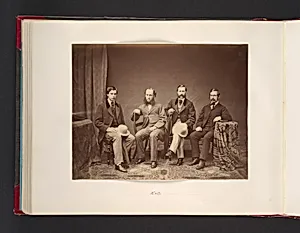
Medium
Albumen silver print from glass negative
Dimensions
23.5 × 30.7 cm (9 1/4 × 12 1/16 in.)
Classification
Photographs
Department
Photographs
Museum
Metropolitan Museum of Art, New York, NY
Credit
Gilman Collection, Purchase, Cynthia Hazen Polsky Gift, 2005
Accession Number
2005.100.583 (87b)
Rights
Public Domain
Tags
Art Historical Context
In 1865, pioneering photographer John Thomson captured *R. & Co.*, an evocative albumen silver print from a glass negative, now housed in The Metropolitan Museum of Art's Gilman Collection. Measuring 23.5 × 30.7 cm, this portrait likely depicts a group of men with a trading firm—possibly the prominent Russell & Co., a key player in 19th-century commerce in China and Hong Kong, where Thomson was based during his early career. Amid the era's British imperial expansion and the Opium Wars' aftermath, such images immortalized the expatriate merchants shaping global trade. Thomson's mastery of the albumen process, which used egg whites to bind light-sensitive silver salts onto paper, produced the medium's signature warm tones, sharp details, and subtle gradations—hallmarks of mid-19th-century photography. This technique allowed for larger, richly textured prints from glass negatives, elevating photography from mere documentation to fine art. As a portrait of professional men, the work reflects Victorian ideals of masculinity, enterprise, and colonial ambition, offering a window into the human stories behind economic empires. Today, *R. & Co.* stands as a testament to Thomson's documentary prowess, later seen in his seminal books like *Foochow and the River Min*. It invites visitors to ponder the intersections of art, commerce, and empire in a rapidly modernizing world.
About the Artist
John Thomson · 1837–1921
John Thomson (1837–1921), a pioneering Scottish photographer, was born on 14 June 1837 in Edinburgh as the eighth of nine children to William Thomson, a tobacco spinner and trader, and Isabella Newlands.) After schooling in the early 1850s, he apprenticed with a local optical and scientific instrument manufacturer, where he mastered the principles of photography, completing his training around 185...