
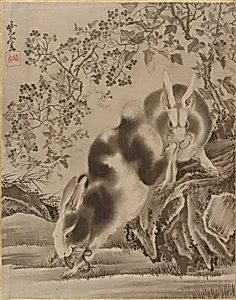
Rabbits
ca. 1887
Medium
Album leaf; ink and color on silk
Dimensions
14 1/4 x 11 1/4 in. (36.2 x 28.6 cm)
Classification
Paintings
Culture & Period
Japan · Meiji period (1868–1912)
Department
Asian Art
Museum
Metropolitan Museum of Art, New York, NY
Credit
Charles Stewart Smith Collection, Gift of Mrs. Charles Stewart Smith, Charles Stewart Smith Jr., and Howard Caswell Smith, in memory of Charles Stewart Smith, 1914
Accession Number
14.76.61.15
Rights
Public Domain
Tags
Art Historical Context
In the late Meiji period (1868–1912), as Japan navigated rapid modernization, artist Kawanabe Kyōsai captured the playful spirit of traditional Japanese painting with *Rabbits* (ca. 1887). Kyōsai, a master of the Kano school and one of the last great ukiyo-e influenced painters, was renowned for his exuberant brushwork, humor, and depictions of animals. This album leaf, an intimate format often collected in bound volumes by connoisseurs, showcases his skill in rendering lively rabbits—symbols of longevity and good fortune in Japanese culture—likely infused with his signature satirical flair. Executed in ink and color on silk, the work exemplifies Kyōsai's dynamic techniques: bold, expressive lines and vibrant pigments that bring the creatures to life on the luxurious, textured surface. At 14¼ × 11¼ inches, its modest scale invites close contemplation, highlighting the tactile elegance of silk as a medium prized for its sheen and absorbency in East Asian art. Part of the Metropolitan Museum of Art's Asian Art collection, gifted in 1914 from the Charles Stewart Smith family, *Rabbits* reflects Meiji-era tensions between tradition and change, preserving Kyōsai's irreverent joy amid societal shifts. A delightful glimpse into Japan's artistic heritage!
About the Artist
Kawanabe Kyōsai 河鍋暁斎 (Japanese) · 1831 –1889
Japanese, 1831–1889