
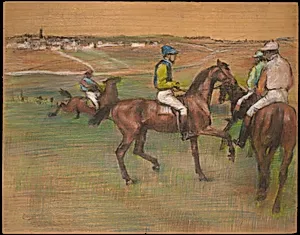
Race Horses
ca. 1885–88
Medium
Pastel on wood
Dimensions
11 7/8 x 16 in. (30.2 x 40.6 cm)
Classification
Drawings
Department
European Paintings
Museum
Metropolitan Museum of Art, New York, NY
Credit
The Walter H. and Leonore Annenberg Collection, Gift of Walter H. and Leonore Annenberg, 1999, Bequest of Walter H. Annenberg, 2002
Accession Number
1999.288.3
Rights
Public Domain
Tags
Art Historical Context
Edgar Degas, a leading figure in the Impressionist movement, captured the energy of horse racing inRace Horses* (ca. 1885–88). Created during his later career, this pastel on wood depicts jockeys and thoroughbreds in mid-action, reflecting Degas' lifelong fascination with the racetrack as a modern spectacle. In 19th-century France, horse at venues like Longchamp was a social event blending aristocracy, gambling, and athleticism, which Degas observed obsessively, sketching from vantage points to freeze fleeting moments of speed and tension. Degas' masterful use of pastel on wood—a sturdy support ideal for the medium's soft, blendable strokes—allowed him to layer vibrant colors and subtle textures, evoking the dust, sweat, and motion of the scene. Unlike oil paintings, pastels offered immediacy and luminosity, aligning with his experimental approach to light and form. Measuring just 11 7/8 x 16 inches, this intimate work showcases his precision in rendering equine anatomy and human poise, hallmarks of his realist-inflected Impressionism. Now in the Metropolitan Museum of Art's European Paintings department as part of the Annenberg Collection, *Race Horses* exemplifies Degas' innovative contributions to drawing and color theory, inviting viewers to feel the thrill of the turf.
About the Artist
Edgar Degas · 1834–1917
Edgar Degas (1834-1917) stands as one of the most innovative artists of the nineteenth century, whose distinctive vision transformed how modern life could be depicted on canvas. Born Hilaire-Germain-Edgar De Gas in Paris to a wealthy banking family—his father French, his mother a Louisiana Creole from New Orleans—Degas received a classical education before abandoning law studies in 1855 to pursue ...