
Rag Doll
c. 1937
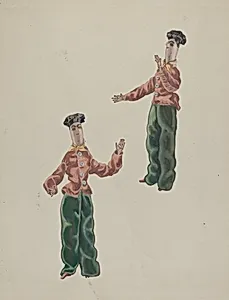
Medium
watercolor, graphite, and gouache on paper
Dimensions
overall: 33.9 x 26.2 cm (13 3/8 x 10 5/16 in.) Original IAD Object: 7" high
Classification
Index of American Design
Department
CG-W
Museum
National Gallery of Art, Washington, D.C.
Credit
Index of American Design
Accession Number
1943.8.15425
Rights
Public Domain
Art Historical Context
### Rag Doll by Verna Tallman Step into the whimsical world of American folk art with *Rag Doll*, a delightful watercolor, graphite, and gouache rendering by Verna Tallman, created around 1937. Measuring 33.9 x 26.2 cm, this work captures the endearing simplicity of a 7-inch-high handmade doll, stitched from fabric scraps with button eyes and a stitched smile. Tallman's precise yet playful depiction highlights the charm of everyday childhood treasures from early 20th-century America. As part of the *Index of American Design*—a groundbreaking Federal Art Project under the Works Progress Administration (WPA) during the Great Depression—this piece belongs to a vast archive of over 18,000 renderings documenting the nation's artistic heritage. From 1935 to 1942, artists like Tallman meticulously recorded folk objects, crafts, and designs to celebrate and preserve American ingenuity amid economic hardship. Housed in the National Gallery of Art's collection, it underscores the cultural value of humble, homemade toys born from resourcefulness. Tallman's mixed-media technique—watercolor for soft hues, gouache for bold opacity, and graphite for fine details—brings the doll's textures and personality to life with museum-quality accuracy. *Rag Doll* invites us to appreciate how ordinary items reflect the warmth and creativity of American home life.
About the Artist
Verna Tallman · 1855–present
Verna Tallman remains a figure about whom the historical record has preserved very little. No birth or death dates have been established, and her nationality and training are not documented in major reference sources. The works attributed to her suggest an engagement with decorative or illustrative traditions, though without more contextual documentation it is difficult to place her within a spec...