
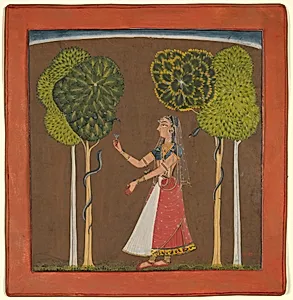
Ragini, possibly Asavari: Folio from a Ragamala Series
Unknown Artist
ca. 1700–1710
Medium
Ink and opaque watercolor on paper
Dimensions
Image: 7 in. × 6 5/8 in. (17.8 × 16.8 cm) Sheet: 8 3/8 × 8 1/8 in. (21.3 × 20.6 cm)
Classification
Paintings
Culture
India (Himachal Pradesh, Mankot)
Department
Asian Art
Museum
Metropolitan Museum of Art, New York, NY
Credit
Rogers Fund, 1918
Accession Number
18.85.1
Rights
Public Domain
Tags
Art Historical Context
This delicate folio, *Ragini, possibly Asavari: from a Ragamala*, originates from Mankot in Himachal Pradesh, India, around 1700–1710. It belongs to the rich tradition of Pahari miniature, where folios from Ragamala series illustrate ragas—melodic frameworks of Indian classical music—and their feminine counterparts, raginis. Each depiction evokes a specific mood, time, or season through poetic imagery, blending art, music, and devotion in 18th-century courtly culture. Rendered in ink and opaque watercolor on paper, the work showcases the precision of Indian miniature techniques: fine ink outlines define graceful forms, while vibrant, non-transparent pigments create luminous depth on a modest 7 × 6⅝-inch sheet. Tags highlighting women, snakes, and trees suggest a serene natural scene, likely symbolizing the mystical or contemplative essence of the Asavari mode, often linked to dawn or forest reveries. As a cultural artifact from the Rogers Fund collection at the Metropolitan Museum of Art, this anonymous masterpiece captures the spiritual harmony of sound and sight in pre-colonial India, inviting visitors to ponder how visuals once accompanied musical performances and poetic recitations.