
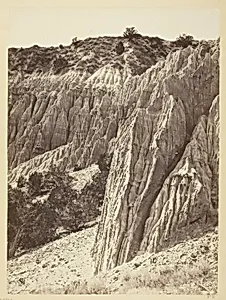
Rain Sculpture, Salt Creek Cañon, Utah
1872
Medium
Albumen print
Dimensions
Image/paper: 27.3 × 20.1 cm (10 3/4 × 7 15/16 in.); Album page: 49.5 × 38.5 cm (19 1/2 × 15 3/16 in.)
Classification
albumen print from collodion negative
Department
Photography and Media
Museum
Art Institute of Chicago
Accession Number
181311
Rights
Public Domain
Art Historical Context
In 1872, William H. Bell captured *Rain Sculpture, Salt Creekñon, Utah* the U.S. Army's Wheeler Survey, a government expedition mapping the uncharted American West. As official photographer, Bell documented Utah's dramatic canyons, showcasing natural wonders like the eroded rock formations in Salt Cañon—poetically titled "Rain Sculpture" for their fluid, sculpted shapes carved by centuries of erosion. This albumen print, measuring about 10¾ × 7⅞ inches, reflects the era's fascination with Manifest Destiny and scientific exploration, bringing remote landscapes to Eastern audiences through exhibitions and publications. Printed from a collodion negative using the albumen process—coating paper with egg whites for a glossy surface and rich tonal depth—Bell's image exemplifies 19th-century photography's technical triumphs. The medium's sensitivity to light allowed crisp details in shadowed crevices and sunlit ridges, turning wilderness into art. Housed in the Art Institute of Chicago's Photography and Media department, this work highlights photography's role in preserving vanishing frontiers, blending documentary precision with aesthetic wonder for generations of viewers.