
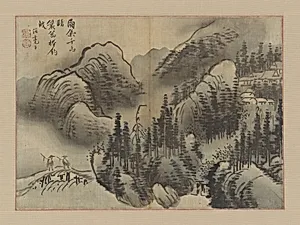
활호자 김수규 산수도 조선|活毫子 金壽奎 山水圖 朝鮮|Rainy Landscape
late 18th century
Medium
Album leaf mounted as a hanging scroll; ink and color on bast fiber
Dimensions
Image: 10 x 13 3/4 in. (25.4 x 34.9 cm) Overall with mounting: 43 1/2 x 18 7/8 in. (110.5 x 47.9 cm) Overall with knobs: 43 1/2 x 21 1/8 in. (110.5 x 53.7 cm)
Classification
Paintings
Culture & Period
Korea · Joseon dynasty (1392–1910)
Department
Asian Art
Museum
Metropolitan Museum of Art, New York, NY
Credit
Purchase, Friends of Asian Art Gifts, 2006
Accession Number
2006.104
Rights
Public Domain
Tags
Art Historical Context
In the late 18th century, Korea's Joseon dynasty (1392–1910), artist Kim Su-gy—known by his pen name Hwalhoja, or "Living Brush Master"— *Rainy Landscape*, a album leaf now elegantly mounted as a hanging scroll Rendered in ink and color on bast paper, a traditional Korean material prized for its absorbency and subtle texture, this work measures just 10 x 13¾ inches at its core, inviting intimate contemplation. Acquired by the Metropolitan Museum of Art in 2006 through the Friends of Asian Art, it exemplifies the refined literati painting tradition that blended scholarly ideals with natural beauty. The painting captures a misty, rain-swept mountain scene, a hallmark of Joseon-era sansu (landscape) art, where towering peaks shrouded in vapor evoke the sublime harmony between humanity and nature—a core Confucian value. Kim's masterful brushwork likely employs layered ink washes to suggest depth and atmosphere, with subtle colors enhancing the wet, ethereal mood. Album leaves like this were originally part of personal collections, easily stored and shared among elites, highlighting their role in cultural exchange and private aesthetic enjoyment. This intimate gem reflects Joseon's artistic evolution, bridging classical Chinese influences with distinctly Korean sensitivity to seasonal transience, offering visitors a window into the poetic soul of 18th-century Korea.