
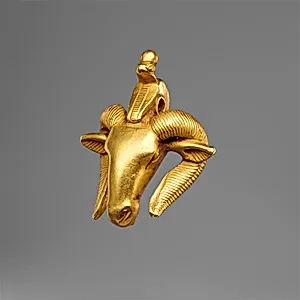
Ram's-head Amulet
Unknown Artist
ca. 712–664 B.C.
Medium
Gold
Dimensions
H. 4.2 × W. 3.6 × D. 2 cm, 65g (1 5/8 × 1 7/16 × 13/16 in., 2.293oz.)
Classification
Amulet, Ram's head
Period
Third Intermediate Period
Department
Egyptian Art
Museum
Metropolitan Museum of Art, New York, NY
Credit
Gift of Norbert Schimmel Trust, 1989
Accession Number
1989.281.98
Rights
Public Domain
Tags
Art Historical Context
This exquisite Ram's-head Amulet, from pure gold around 712–664 B.C., hails from Egypt's Third Intermediate Period during Dynasty 25, the Kushite era. Measuring just 4.2 cm high, this petite treasure— weighing a mere 65 grams—was likely worn as a protective pendant, its detailed ram's head symbolizing strength and divine power. Gold, a metal revered by ancient Egyptians for its eternal shine and association with the gods, underscores the amulet's role as a high-status object, possibly invoking safeguarding magic in daily life or the afterlife. The Kushite dynasty, ruled by Nubian kings from the south, marked a revival of traditional Egyptian artistry and religion after periods of fragmentation. Rams held profound symbolism, often linked to the god Amun, whose cult flourished under these pharaohs. This amulet exemplifies the period's masterful metalworking, with its compact, realistic sculpting capturing the ram's alert features in remarkable detail for such a small scale. Today, this gift to the Metropolitan Museum of Art from the Norbert Schimmel Trust invites us to ponder the enduring spiritual beliefs of ancient Egypt, where even tiny adornments bridged the mortal world and the divine.