
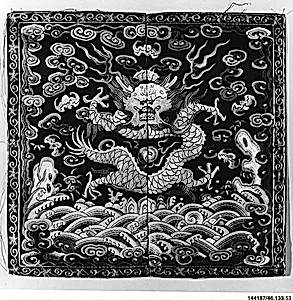
Rank Badge with Four-Clawed Dragon
Unknown Artist
mid-18th century
Medium
Silk, metallic thread
Dimensions
12 1/2 x 12 3/4 in. (31.75 x 32.38 cm)
Classification
Textiles-Embroidered
Culture & Period
China · Qing dynasty (1644–1911)
Department
Asian Art
Museum
Metropolitan Museum of Art, New York, NY
Credit
Anonymous Gift, 1946
Accession Number
46.133.53
Rights
Public Domain
Tags
Art Historical Context
This exquisite Rank Badge with Four-Clawed Dragon, in the mid-18th century during China's Qing dynasty (16441911), exemplifies the opulent textiles worn by imperial officials. Square in shape and measuring about 12½ x 12¾ inches, these embroidered patches—known as *buziguan* or mandarin squares—were sewn onto the chest and back of formal robes to publicly display the wearer's rank. The central motif of four-clawed dragons, rendered in vibrant silk and shimmering metallic threads, signified high-ranking civil or military officials, distinguishing them from the emperor's exclusive five-clawed imperial dragons. The artistry shines through meticulous embroidery techniques, blending fine silk couching, satin, and chain stitches to create dynamic, scale-textured dragons amid swirling clouds. Auspicious bats, symbols of happiness (*fu*) and longevity due to their homophonic name in Chinese, add layers of good fortune, a common motif in Qing decorative arts. Metallic threads catch the light, evoking the grandeur of court life and the wearer's status. Preserved through an anonymous gift to the Metropolitan Museum of Art in 1946, this badge offers a window into Qing bureaucratic hierarchy and the era's masterful textile traditions, where every stitch conveyed power and prosperity.