
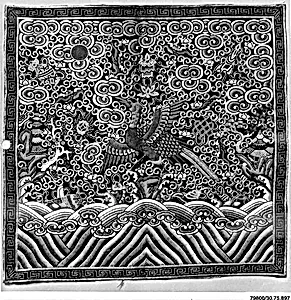
Rank Badge with Golden Pheasant
Unknown Artist
early 19th century
Medium
Silk, metallic thread
Dimensions
11 3/4 x 12 in. (29.84 x 30.48 cm)
Classification
Textiles-Embroidered
Culture & Period
China · Qing dynasty (1644–1911)
Department
Asian Art
Museum
Metropolitan Museum of Art, New York, NY
Credit
Bequest of William Christian Paul, 1929
Accession Number
30.75.897
Rights
Public Domain
Tags
Art Historical Context
This exquisite *Rank Badge with Golden Pheasant*, crafted early 19th-century China during the Qing dynasty (164–1911), served as a vital symbol of imperial hierarchy. Worn on the chest and back of officials' surcoats, these square *biao* badges denoted rank through embroidered motifs. The golden pheasant, depicted here in vibrant splendor, marked a first-rank civil official—reserved for the empire's highest bureaucrats, embodying beauty, grace, and moral virtue in Confucian ideals. Masterfully embroidered on silk with shimmering metallic threads, the badge measures about 12 inches square, showcasing intricate techniques like couching and satin stitch that catch the light to mimic the bird's iridescent plumage. Such textiles blended artistry with function, produced in imperial workshops where skilled embroiderers layered colors and metals for durability and prestige. Today, housed in the Metropolitan Museum of Art's Asian Art Department (Bequest of William Christian Paul, 1929), this badge offers a window into Qing society's rigid structure and opulent craftsmanship, reminding us how clothing encoded power in imperial China.