
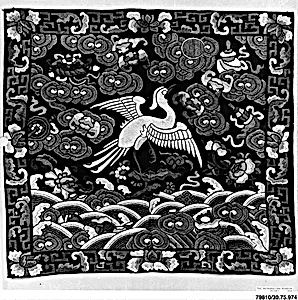
Rank Badge with Paradise Fly-Catcher
Unknown Artist
late 18th–early 19th century
Medium
Silk on silk
Dimensions
11 3/4 x 12 1/2 in. (29.84 x 31.75 cm)
Classification
Textiles-Embroidered
Culture & Period
China · Qing dynasty (1644–1911)
Department
Asian Art
Museum
Metropolitan Museum of Art, New York, NY
Credit
Bequest of William Christian Paul, 1929
Accession Number
30.75.974
Rights
Public Domain
Tags
Art Historical Context
This exquisite Rank Badge with Paradise Fly-Catcher, in China during the late 18th to early 19th century the Qing dynasty (1644–1911), exemplifies the imperial bureaucracy's rigid hierarchy. These embroidered silk squares, known as *biao* or mandarin squares, were sewn onto the chests and backs of officials' robes to publicly denote their rank. Civil officials wore bird motifs, with the Paradise Fly-Catcher vibrant, long-tailed bird symbolizing grace and agility—indicating the sixth rank, a mid-level position in the vast administrative system that governed the empire. Rendered in silk-on-silk embroidery, the badge showcases masterful *couched* and *satin* stitching techniques, creating shimmering textures and lifelike details. The fly-catcher's iridescent feathers, perched amid floral motifs, reflect Qing artisans' skill in capturing nature's beauty while adhering to sumptuary laws that regulated colors and symbols—blue for civil ranks. Such textiles were status symbols, blending artistry with Confucian ideals of order. Now at the Metropolitan Museum of Art (Bequest of William Christian Paul, 1929), this 11 3/4 x 12 1/2 in. treasure offers a glimpse into daily life at the Forbidden City's court, where every thread reinforced social structure. (198 words)