
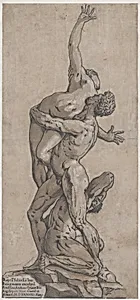
Rape of a Sabine Woman
Medium
Chiaroscuro woodcut from three blocks in gray-brown
Dimensions
Sheet: 17 3/16 × 7 15/16 in. (43.7 × 20.2 cm)
Classification
Prints
Department
Drawings and Prints
Museum
Metropolitan Museum of Art, New York, NY
Credit
Rogers Fund, 1922
Accession Number
22.73.3-70
Rights
Public Domain
Tags
Art Historical Context
In the late Renaissance, Andrea Andreani, a masterful Italian printmaker, captured the dramatic intensity of Giambologna's Mannerist sculpture *Rape of a Sabine* in this 1584 chiaroscurocut. Drawing from the ancient Roman legend where Roman men abducted Sabine women to secure Rome's future, the print depicts a muscular male figure dynamically hoisting a struggling nude woman—emblematic of Giambologna's swirling, anatomically precise compositions that emphasized movement and emotion over classical harmony. Andreani's technique shines through his innovative use of three gray-brown woodblocks, creating subtle tonal gradations that mimic the chiaroscuro (light-dark) modeling of sculpture and painting. This rare print medium, perfected in the 16th century, elevated woodcuts from mere reproductions to artistic works in their own right, bridging fine art and mass dissemination. Measuring 17 3/16 × 7 15/16 inches, it showcases intertwined male and female nudes, highlighting Renaissance fascination with the idealized human form. Acquired by The Metropolitan Museum of Art via the Rogers Fund in 1922, this piece exemplifies how prints preserved and popularized elite sculptures, making Mannerist drama accessible to collectors across Europe. A testament to artistic collaboration and technical prowess, it invites viewers to ponder the myth's raw energy and the era's bold exploration of the body.