
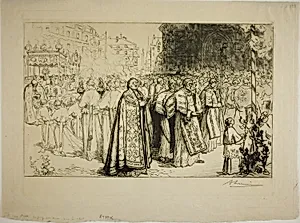
Re-entry of the Procession into Nantes Cathedral
Medium
Etching and drypoint on cream wove paper
Dimensions
Image: 16.6 × 26.8 cm (6 9/16 × 10 9/16 in.); Plate: 19.1 × 27.3 cm (7 9/16 × 10 3/4 in.); Sheet: 23.9 × 32.1 cm (9 7/16 × 12 11/16 in.)
Classification
etching
Department
Prints and Drawings
Museum
Art Institute of Chicago
Accession Number
46320
Rights
Public Domain
Art Historical Context
In the etching *Re-entry of the Procession into Nantes Cathedral* (1901), French artist Louis Auguste Lepère captures a moment of solemn grandeur at the Cathedral of St. Peter and St. Paul in Nantes. Created during the Belle Époque, this print depicts a religious procession returning to the Gothic masterpiece, a symbol of French Catholic heritage completed in the 15th century. Lepère, renowned for his meticulous renderings of urban architecture and everyday life, draws viewers into the scene's rhythmic flow of figures and ornate details, evoking the pageantry of turn-of-the-century France. Lepère's mastery shines in his use of etching and drypoint on cream wove paper. Etching allows for precise, fluid lines etched into a metal plate with acid, while drypoint adds velvety burrs from direct needle scratches, creating rich textures and depth in the procession's fabrics, stone facade, and shadows. Measuring just 16.6 × 26.8 cm, the intimate scale invites close inspection, highlighting Lepère's place among fin-de-siècle printmakers who elevated the medium as an art form rivaling painting. Housed in the Art Institute of Chicago's Prints and Drawings collection, this work offers a window into Lepère's passion for preserving vanishing traditions amid modernization, blending historical reverence with technical innovation for enduring appeal.
About the Artist
Louis Auguste Lepère · 1849–1918
Louis-Auguste Lepère (1849–1918) was born in Paris on November 30 to the sculptor François Lepère, immersing him early in the artistic world. At age thirteen, he apprenticed in the studio of the English wood engraver Joseph Burn-Smeeton, training there from 1862 to 1867, and later attended drawing courses under Horace Lecoq de Boisbaudran at the Petite École (now École nationale supérieure des art...