
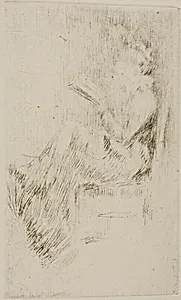
Reading a Book
1873/74
Medium
Drypoint, with drypoint cancellation, in black ink on ivory laid paper
Dimensions
Plate: 12.6 × 7.6 cm (5 × 3 in.); Sheet, sight, bound: 38 × 23.9 cm (15 × 9 7/16 in.)
Classification
drypoint
Department
Prints and Drawings
Museum
Art Institute of Chicago
Accession Number
190698
Rights
Public Domain
Art Historical Context
James McNeill Whistler’s *Reading a Book* (1873/74) captures an intimate moment of quiet contemplation, rendered in drypoint—a technique where the artist scratches directly into copper plate with a sharp tool, raising a soft burr that produces rich, velvety lines. Printed in black ink on ivory laid paper, this small plate (just 12.6 × 7.6 cm) Whistler’s mastery of subtle tone and texture during his experimental printmaking phase in the 1870s. The deliberate "drypoint cancellation"—scratching the plate to prevent further printings—ensures its rarity, housed today in the Art Institute of Chicago’s Prints and Drawings collection. Whistler, an American expatriate in London and champion of Aestheticism, prioritized harmony and suggestion over narrative detail, influencing the shift toward modernism in printmaking. This work reflects his fascination with everyday subjects, transforming a simple act of reading into a poetic study of light and shadow. Produced amid his broader innovations in etching and lithography, it showcases how drypoint’s tactile burr allowed for expressive, painterly effects unattainable in traditional line engraving. Visitors will appreciate the artwork’s delicate scale, inviting close inspection to reveal the ink’s soft burr and the paper’s creamy texture—hallmarks of Whistler’s pursuit of “art for art’s sake.” A gem from his prolific 1870s output, it bridges 19th-century realism with impressionistic subtlety. (198 words)
About the Artist
James McNeill Whistler · 1834–1903
James Abbott McNeill Whistler (1834-1903) was an American-born painter and printmaker who became a leading figure in the Aesthetic Movement and pioneer of Tonalism and Japonisme. He revolutionized art by championing "art for art's sake" and treating paintings as visual equivalents of musical compositions, titling works as "arrangements," "harmonies," and "nocturnes" to emphasize formal qualities o...