
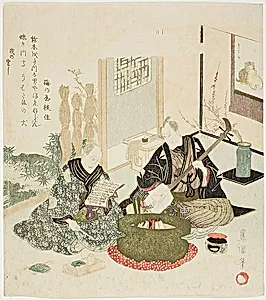
Reading and Playing Shamisen in Winter
late 18th to early 19th century
Medium
Color woodblock print; surimono
Dimensions
21.8 × 19.6 cm (8 5/8 × 7 3/4 in.)
Classification
woodblock print
Department
Arts of Asia
Museum
Art Institute of Chicago
Accession Number
81411
Rights
Public Domain
Art Historical Context
In the intimate scene of *Reading and Playing Shamisen Winter*, Utagawaokuni I captures a moment of leisure amid Japan's Edo period (1603–1868). as a *surimono*—a luxurious, privately commissioned woodblock print often exchanged as New Year's greetings—this late 18th- to early 19th-century work reflects the ukiyo-e tradition, or "pictures of floating world," celebrating everyday beauty and transient pleasures. Toyokuni, a master of the Utagawa school renowned for his vibrant actor portraits and bijin-ga (images of beautiful women), here depicts figures engaged in reading and strumming the shamisen, a three-stringed instrument central to kabuki theater and folk music, evoking winter's quiet introspection. The print's compact size (21.8 × 19.6 cm) and color woodblock technique highlight surimono's artistry: intricate carving allowed for bold hues, subtle gradations (*bokashi*), and sometimes metallic accents or embossing for texture. Produced in limited editions for elite patrons, these prints were more refined than mass-market ukiyo-e, blending poetry, calligraphy, and imagery. Toyokuni's fluid lines and expressive poses infuse the winter setting with warmth, underscoring cultural values of refinement (*iki*) and harmony in domestic life. Housed in the Art Institute of Chicago's Arts of Asia department, this gem offers a window into Edo Japan's thriving print culture, where art democratized beauty for poetry lovers and music enthusiasts alike.
About the Artist
Utagawa Toyokuni I · 1777–1835
Japanese, 1777–1835