
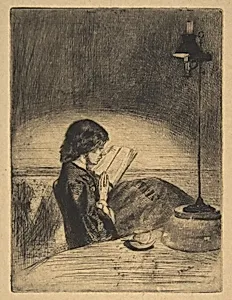
Reading by Lamplight
Medium
Etching and drypoint, printed in black ink on fine tan fibrous oriental paper; third state of three (Glasgow)
Dimensions
plate: 6 1/4 x 4 5/8 in. (15.9 x 11.7 cm) sheet: 8 1/2 x 6 1/2 in. (21.6 x 16.5 cm)
Classification
Prints
Department
Drawings and Prints
Museum
Metropolitan Museum of Art, New York, NY
Credit
Gift of William Loring Andrews, 1883, transferred from the Library
Accession Number
83.1.31
Rights
Public Domain
Tags
About this artwork
[Research in progress for Reading by Lamplight by James McNeill Whistler, 1859]
Art Historical Context
**Reading by Lamplight a delicate etching and drypoint by James McNeill Whistler from 1859, captures intimate moment of a woman absorbed in reading under the soft glow of lamplight. Created during Whistler's early career in Paris where he immersed himself in printmaking, this work exemplifies his shift toward Realism influenced by French artists like Courbet. The third state of three, as catalog in the Glasgow edition, reflects Whistler's meticulous revisions, adding rich textures through drypoint burrs that lend a velvety depth to the black ink. Printed on fine tan fibrous oriental paper—a nod to Whistler's growing fascination with Japanese aesthetics—the modest plate (6 1/4 x 4 5/8 in.) invites close viewing, emphasizing subtle tones and atmospheric light. Etching allowed precise lines for the figure and furnishings, while drypoint's softness evokes the quiet hush of evening study, a theme resonant in Victorian domestic life. Now in the Metropolitan Museum of Art's Drawings and Prints department, gifted in 1883, this print highlights Whistler's innovative print techniques, bridging 19th-century precision with impressionistic freedom. A gem for print enthusiasts, it whispers of quiet contemplation amid the era's industrial bustle.
About the Artist
James McNeill Whistler · 1834–1903
James Abbott McNeill Whistler (1834-1903) was an American-born painter and printmaker who became a leading figure in the Aesthetic Movement and pioneer of Tonalism and Japonisme. He revolutionized art by championing "art for art's sake" and treating paintings as visual equivalents of musical compositions, titling works as "arrangements," "harmonies," and "nocturnes" to emphasize formal qualities o...