
Reapers
George Stubbs, 1791
About this artwork
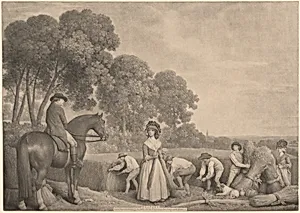
George Stubbs's *Reapers* (1791) captures the essence of rural British life in the late 18 century through a masterful print executed in stipple and roulette on paper. Renowned for his precise anatomical studies of horses and wildlife, Stubbs (1724–1806) here turns his keen eye to human figures engaged in the harvest, evoking the timeless rhythm of agrarian labor amid the Enlightenment era's fascination with nature and industry. Measuring 19 × 27 inches and trimmed to the platem, this work exemplifies Stubbs's late-career experimentation with printmaking, allowing broader access to his detailed compositions beyond elite oil paintings. The medium is particularly noteworthy: stipple engraving builds subtle tones and textures through fine dots, while the roulette—a wheeled tool—imparts delicate, wavy lines for shading and depth, mimicking the softness of watercolor or etching. Laid paper, with its visible chain lines, was a favored support for high-quality prints of the period, enhancing the artwork's tactile appeal. As a print from the National Gallery of Art's collection—acquired through the Krugman Family Foundation Fund and an anonymous donor—*Reapers* highlights Stubbs's technical innovation and his role in democratizing art for a growing middle class. This piece invites visitors to ponder the interplay of human endeavor and the natural world, a recurring theme in Stubbs's oeuvre that bridged scientific observation with artistic poetry.