
清 余奏言、顏炳 望雲山莊後圖八景 卷|Rear View of the Mountain Villa for Watching Clouds
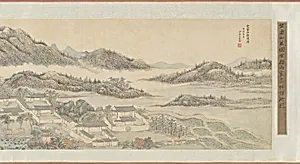
Medium
Handscroll; ink and color on paper
Dimensions
Frontispiece: 12 7/8 x 51 in (32.8 x 129.3 cm); Painting by Yu Zouyan: 12 7/8 x 39 5/8 in (32.9 x 100.5 cm); Poems by Zhang Xianghe: 12 1/4 x 74 1/2 in (31.1 x 189.2 cm); Painting by Yan Bing: 12 3/8 x 78 1/2 in (31.3 x 199.5 cm
Classification
Paintings
Culture & Period
China · Qing dynasty (1644–1911)
Department
Asian Art
Museum
Metropolitan Museum of Art, New York, NY
Credit
Purchase, Robert Hatfield Ellsworth Bequest, 2021
Accession Number
2021.390
Rights
Public Domain
Art Historical Context
This exquisite Qing dynasty handscroll, titled *Rear View of the Mountain Villa for Watching Clouds* (望雲山莊後圖八景卷), captures the serene beauty of a literati retreat through collaborative artistry. Created in 1844–45, it features paintings by Yu Zouyan and Yan Bing, complemented by poems from Zhang Xianghe. Unfurling to reveal eight scenic views from the villa's rear, the work invites viewers to slowly unroll its 12 7/8-inch-high expanse, immersing them in layered landscapes of mist-shrouded peaks, pavilions, and winding paths. Rendered in ink and color on paper—a hallmark of Chinese scroll painting—the artwork exemplifies the Qing era's fusion of visual poetry and calligraphy. Handscrolls like this were treasured among scholars for private contemplation, blending naturalistic detail with expressive brushwork to evoke harmony between humans and nature. The integration of Zhang Xianghe's verses alongside the images heightens its emotional depth, reflecting the literati ideal of retreating to mountain villas for contemplation amid political turbulence. Acquired by the Metropolitan Museum of Art in 2021 through the Robert Hatfield Ellsworth Bequest, this piece offers a window into mid-19th-century Chinese culture, where art served as both aesthetic delight and philosophical refuge. (198 words)
About the Artist
Yan Bing|Zhang Xianghe|Yu Zouyan (Chinese|Chinese|Chinese) · |1785 | – |1862 |
Chinese, 19th century|Chinese, 1785–1862|Chinese, 19th century