
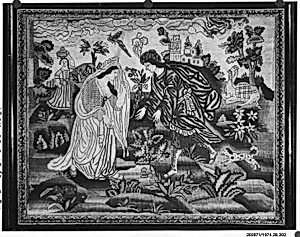
Rebecca at the Well
Unknown Artist
ca. 1700
Medium
Silk and wool
Dimensions
H. 21 1/2 x W. 26 1/4 inches (54.6 x 66.7 cm); Framed: H. 29 1/4 x W. 34 x D. 2 1/4 inches (74.3 x 86.4 x 5.7 cm)
Classification
Textiles-Embroidered
Culture
British
Department
European Sculpture and Decorative Arts
Museum
Metropolitan Museum of Art, New York, NY
Credit
Bequest of Irwin Untermyer, 1973
Accession Number
1974.28.202
Rights
Public Domain
Tags
Art Historical Context
**Rebecca at the Well**, exquisite embroidered textile from around 1700, captures a timeless biblical scene from Genesis 24. Here, Rebecca encounters Abraham's servant Eliezer at a well in ancient Mesopotamia, offering water to him and his camels—a pivotal moment symbolizing hospitality and divine providence. Crafted by an unknown British artist, this work features men, women, camels,, and dogs, ev a vibrant narrative tableau rich in symbolic detail. Rendered in silk and wool on a modest scale (21½ × 26¼ inches), the piece exemplifies early 18th-century British embroidery, a popular domestic art form among women that blended storytelling with technical virtuosity. The use of lustrous silk for highlights and wool for depth allowed for textured landscapes and lively figures, showcasing meticulous stitching techniques like satin and stem stitches. Such pictorial embroideries were prized as both decorative furnishings and personal expressions of faith. Now housed in the Metropolitan Museum of Art's Department of European Sculpture and Decorative Arts, thanks to the 1973 bequest of Irwin Untermyer, this artifact highlights the cultural importance of needlework in British homes, bridging religious devotion with artistic innovation. Visitors will appreciate its delicate beauty and the enduring appeal of its ancient tale.