
Reclining Female Nude
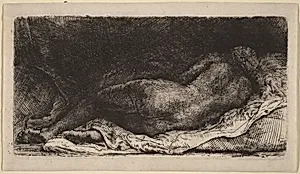
Medium
etching, drypoint and burin
Classification
Department
CG-E
Museum
National Gallery of Art, Washington, D.C.
Credit
Rosenwald Collection
Accession Number
1943.3.7206
Rights
Public Domain
Art Historical Context
In 1658, Rembrandt van Rijn, the Dutch Baroque master renowned for his dramatic use of light and shadow, created *Reclining Female Nude*, a striking etching enriched with drypoint and burin work. This intimate print captures a serene female figure in repose, embodying the sensual yet contemplative nudes that fascinated 17th-century artists amid the Dutch Golden Age. Produced during Rembrandt's later years in Amsterdam—marked by personal hardships yet artistic innovation—the piece reflects his shift toward more personal, expressive subjects rather than grand historical scenes. Rembrandt's technical prowess shines here: etching forms the foundational lines, while drypoint adds velvety burrs for lush tonal depth, and the burin refines details with crisp precision. These combined methods allowed unprecedented richness in black-and-white prints, making them rival paintings in texture and emotion. As part of the National Gallery of Art's Rosenwald Collection, this work exemplifies how Rembrandt elevated printmaking from reproductive tool to fine art, influencing generations. For visitors, this nude invites reflection on the human form's timeless beauty, blending eroticism with profound humanity—a hallmark of Rembrandt's empathetic gaze.
About the Artist
Rembrandt van Rijn · 1606–1669
Rembrandt Harmenszoon van Rijn (1606–1669) stands as one of the greatest visual artists in the history of Western art and the most important Dutch painter of the 17th century. Born in Leiden to a prosperous miller's family, Rembrandt transformed painting through his revolutionary use of light and shadow, his psychological depth in portraiture, and his elevation of etching to a fine art. His approx...