
Reclining Model (Le Repos du modèle)
c. 1922
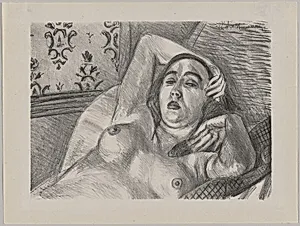
Medium
lithograph on wove paper
Dimensions
sheet: 25.4 × 33.02 cm (10 × 13 in.) framed: 51.44 × 55.88 × 190.5 cm (20 1/4 × 22 × 75 in.)
Classification
Department
CG-E
Museum
National Gallery of Art, Washington, D.C.
Credit
Gift of the Mark D. and Jeannie M. Golub Trust
Accession Number
2021.120.1
Rights
Public Domain
Art Historical Context
In early 1920s Henri Matisse worked repeatedly from live models in his studio, turning to lithography as a way to record the body in states of rest and to test how form and pattern could coexist on the page. The print places the figure against a wall of repeating floral and scroll motifs, so that the dense cross-hatching that builds the torso and limbs stands in direct contrast with the lighter, more open marks of the background. This choice makes the model’s weight and volume feel anchored while the surrounding design remains airy and decorative, shifting attention from any single contour to the interplay between solid flesh and repeating ornament. Drawn around 1922 and printed as a lithograph on wove paper, the sheet now belongs to the National Gallery of Art. Look at the hand resting near the temple: the short, curved strokes that describe the fingers also suggest the slight pressure of skin against skin, giving the pose its quiet, momentary stillness.
About the Artist
Henri Matisse · 1869–1954
Henri Matisse (1869-1954) was a French painter, draughtsman, printmaker, and sculptor who is widely regarded as one of the most influential artists of the 20th century and the greatest colorist of his era. Born in Le Cateau-Cambresis in northern France, Matisse initially studied law before discovering his passion for art during a period of convalescence at age 20. He became the leading figure of F...