
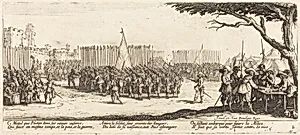
Recruitment of Troops
c. 1633
Medium
etching on laid paper
Dimensions
plate: 8.3 × 18.1 cm (3 1/4 × 7 1/8 in.) sheet: 13.5 × 24.3 cm (5 5/16 × 9 9/16 in.)
Classification
Department
CG-E
Museum
National Gallery of Art, Washington, D.C.
Credit
R.L. Baumfeld Collection
Accession Number
1969.15.767
Rights
Public Domain
Art Historical Context
Jacques Callot's *Recruitment of Troops*c. 1633) is a poignant etching that captures the gritty realities of wartime mobilization during the Thirty Years' War (1618–1648), a devastating conflict that ravaged Europe. As one of the earliest plates in Callot's seminal series *The Miseries and Misfort of War*, it depicts recruiters enticing or coercing villagers into military service amid the chaos of the French invasion of Lorraine. Callot, a masterful French Baroque printmaker (15921635), drew from his firsthand observations in his native region, blending sharp social commentary with unflinching detail to expose war's human toll. Rendered as an etching on laid paper, the work measures a modest plate size of 8.3 × 18.1 cm, yet Callot's virtuoso technique—using multiple acid bites for intricate lines—packs a bustling scene with dozens of figures: swaggering soldiers, hesitant recruits, and anxious onlookers. This innovative approach allowed for unprecedented narrative density in prints, making the medium accessible for wide dissemination and influencing later artists like Goya. Housed in the National Gallery of Art's R.L. Baumfeld Collection (Department CG-E), this print remains a powerful testament to Callot's humanitarian vision, urging viewers to reflect on the personal costs of conflict. Its small scale belies its cultural weight, inviting close inspection to uncover the drama etched within.
About the Artist
Jacques Callot · 1592–1635
Jacques Callot (1592–1635) was a French printmaker and draftsman from the Duchy of Lorraine, widely regarded as one of the first great artists to practice the graphic arts exclusively. His more than 1,400 etchings chronicled the breadth of 17th-century life, from Medici court festivities to the brutal realities of warfare. Callot revolutionized etching through technical innovations including the é...