
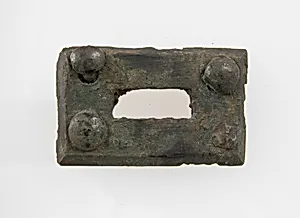
Rectangular Plaque
Unknown Artist
500–700
Medium
Copper alloy
Dimensions
Overall: 1 1/4 x 3/4 x 1/4 in. (3.1 x 1.9 x 0.7 cm)
Classification
Metalwork-Copper alloy
Culture
Frankish
Department
Medieval Art
Museum
Metropolitan Museum of Art, New York, NY
Credit
Gift of J. Pierpont Morgan, 1917
Accession Number
17.193.201
Rights
Public Domain
Art Historical Context
This delicate Rectangular Plaque, crafted by an unknown Frankish artist between 500 and 700 CE, exemplifies exquisite metalwork of early medieval Europe. Measuring just 1¼ x ¾ x ¼ inches, this copper alloy piece—likely used as a decorative mount for jewelry, belts, or reliquariesshowcases the Franks' mastery of small-scale artistry during the Merovingian period. The choice of copper alloy, a durable and malleable material blending copper with tin or zinc, allowed for intricate detailing through casting, engraving, or repoussé techniques, making such objects both functional and status symbols. In the turbulent post-Roman world, the Franks—a Germanic people who dominated Gaul (modern France and Germany)—produced metalwork that bridged late antiquity and the Middle Ages. These plaques often featured geometric patterns, animal motifs, or Christian symbols, reflecting emerging Carolingian influences and the fusion of pagan and Christian traditions. This artifact highlights the era's itinerant craftsmanship, where workshops created portable treasures for elites and clergy. Today, housed in the Metropolitan Museum of Art's Medieval Art department as a gift from J. Pierpont Morgan in 1917, the plaque invites us to marvel at its survival across 1,300 years. Though diminutive, it whispers of a vibrant Frankish culture where metalwork preserved beauty amid change.