
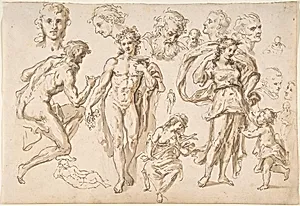
Recto: figure and head-studies (including Bacchus); Verso: four main figure studies repeated from the recto
1745–1815
Medium
Recto: pen and brown ink, brown wash and red chalk; Verso: red chalk and pen and black ink
Dimensions
7 15/16 x 11 5/8 in. (20.2 x 29.5 cm)
Classification
Drawings
Department
Drawings and Prints
Museum
Metropolitan Museum of Art, New York, NY
Credit
The Elisha Whittelsey Collection, The Elisha Whittelsey Fund and Harry G. Sperling Fund, 2003
Accession Number
2003.508
Rights
Public Domain
Tags
Art Historical Context
This double-sided drawing by Bartholomaeus Ign Weiss (1745–1815), a lesser-known draftsman active in the late 18th and early th centuries, showcases the artist's meticulous study of the human form. On the recto, Weiss presents figure and head studies, including a depiction of Bacchus, the Roman god of wine, alongside male nudes, profiles, and portraits of both men and women. The verso repeats four principal figures from the front, suggesting an iterative process typical of preparatory sketches for paintings or larger compositions. Crafted on a modest sheet measuring 7 15/16 x 11 5/8 inches, the recto employs pen and brown ink with brown wash and red chalk, creating dynamic contrasts and subtle modeling that bring the figures to life. The verso shifts to red chalk and pen with black ink, allowing for bolder outlines and tonal variations. These mixed-media techniques, rooted in the academic tradition of the Enlightenment era, highlight Weiss's skill in capturing anatomy, expression, and classical motifs amid Europe's fascination with antiquity. Housed in the Metropolitan Museum of Art's Drawings and Prints department, this work exemplifies how artists like Weiss honed their craft through repetitive study, bridging Rococo elegance and emerging Neoclassicism. Visitors will appreciate its intimate scale and the lively energy of these figures, offering a window into the creative workshop of a bygone age.